
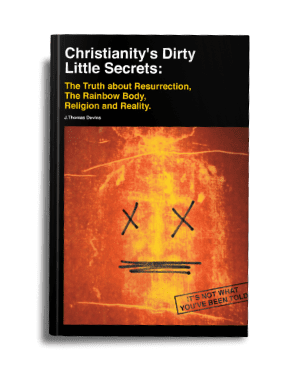
Christianity’s Dirty Little Secrets
The Truth About Resurrection, The Rainbow Body, Religion And Reality
What is Christianity’s dirty little secret? It’s this. That which happened to Jesus on the first Easter Sunday is within the capability of every living human being. In other words, there was no Easter Sunday miracle. Common, spiritually perfected people in the Tibetan Buddhist tradition have been “resurrecting” since before the Christian era. The phenomenon is called rainbow body.
The book reports on the author’s 2018 trip to Tibet where he investigated two recent rainbow body deaths. There he found impressive memorials to the men, witnessed the great devotion and respect that is given, spoke to eyewitnesses and stood over the spots where the dissolutions took place.
While the rainbow body phenomenon is virtually unknown in the West, it is well known in Tibet, especially in the monastic community where it is nearly universally acknowledged. In fact, a school at the Dzogchen monastery actually teaches how to attain rainbow body. At the time of the visit, twenty-two students were enrolled.
The book gives the reader insight into both the rainbow body phenomenon, its far reaching implications and the Tibetan culture. It is a culture where spirits seem to outnumber the human population by a wide margin. The book also includes a description of the yogic practice that rainbow body adepts follow. It is called Dzogchen. The teachings of the forgotten text known as the Gospel of Thomas, a Jesus sayings gospel, are a Westernized version of Dzogchen and are likewise covered. Rainbow body (resurrection) is consistent with the science of the atom and its well-known dual nature.
Rainbow body attests to the naturalness of what Christians mistakenly refer to as Jesus’s miracle resurrection.
The book is available on Amazon.
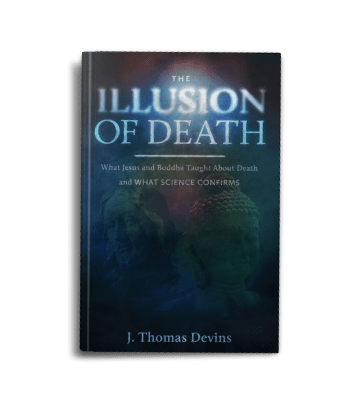
The Illusion of Death
What Jesus and Buddah Taught About Death and What Science Confirms
The book centers on strange deaths that have taken place over the course of history in the Hindu, Tibetan Buddhist and biblical traditions where the deceased left no corpse behind. The Tibetan rainbow body phenomenon is of particular interest because it occurs in modern times.
Jesus’s resurrection is also singled out. Unlike the other deaths, His is held to be miraculous, God’s direct intervention in human affairs. Jesus’s crucified corpse is said to have taken on new life in the tomb and bodily arose. Research on the Shroud of Turin—and don’t be misled, it is Jesus’s actual burial cloth—tells a very different story. There was no bodily resurrection. That which is called resurrection is, like the other strange deaths, the natural way the body is designed to gracefully exit the planet. Moreover, the teachings in a forgotten text called the Gospel of Thomas lay out the state of mind which is required in order to die a corpse-less death. The Thomas teachings parallel the very practices the Tibetan Buddhists follow in achieving rainbow body.
Reality, as the great quantum scientists tell us, is merely an illusion, a state of mind as is death. The book backs up that statement with cold, hard fact. But the notion is soundly rejected by faith based Western religions where belief overrides fact, especially by Christianity due to its heavy investment in a resurrection miracle.
The book is available on Amazon.
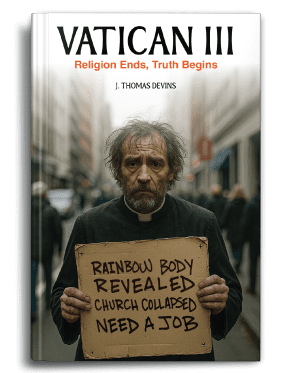
VATICAN III - Religion Ends, Truth Begins
Vatican II laid the groundwork for a revolutionary reconciliation between foundational Catholic doctrine and the modern world. The problem is this. The Council chose the wrong modern world to reconcile with.
There are two realities: the Post-Big Bang world and the Pre-Big Bang realm that underlies it. The Post-Big Bang world is the realm of form and flesh, religion, rat-race, and law — a world defined by sensory perception. The Pre-Big Bang, by contrast, is a fecund quantum field in which particles continuously flicker in and out of existence. And as every mystic and quantum physicist knows, it is not inert and is conscious. It stretches and contorts in response to the movement of the bodies within it. In doing so, it manipulates time itself: as space contorts, time slows for the body doing the contorting.
By focusing its reform efforts solely on the Post-Big Bang world, Vatican II overlooked the deeper reality and violated one of Jesus’s fundamental teachings. In Mark 8:36–37, Jesus asks, “What profit is there for one to gain the whole world and forfeit his life?” Life in the sensory world is fleeting. True life — lasting, eternal, and free — is found only in the realm that transcends it.
Vatican III must correct this oversight. This book proposes practical, transformative insights to guide that future Council. But readers need not wait. The path forward begins now. As with all great journeys, the best way to finish is to start.
This book builds on the wisdom of the most influential thinker of our time — Albert Einstein. Both Buddha and Jesus taught the importance of looking beyond the surface diversity of forms in the Post-Big Bang world to discover a deeper sameness. Their teachings were resisted by entrenched systems: the rigid caste hierarchies of the East and the authoritarian monotheism of the West. But Einstein captured their insight mathematically in his iconic equation: E=mc². Energy (“E”) and mass (“m”) are two sides of the same coin. Everything is made of energy — and energy is the substance of sameness.
When sameness prevails, something extraordinary happens: the Self disappears. The mental construct that says “I am different from that” loses meaning. There is no longer anything to be different from.
This brings us to the rainbow body phenomenon — a Tibetan Buddhist tradition in which practitioners who realize selflessness literally vanish into light. So too did Jesus’s body disappear on the first Easter Sunday. Salvation, it turns out, is not found in palatial cathedrals, ornate liturgies, or jeweled chalices. It is a matter of the mind.
Here lies the paradox: the path to selflessness requires no priestly intermediary. In fact, the priest becomes an obstacle — because his very role is to mediate difference, not dissolve it. The priest on the cover of this book has done nothing wrong; he honored his vows and served faithfully. But when the goal is the elimination of the Self, his role becomes obsolete. The religion he practiced was only training wheels for the higher reach of spiritual perfection — the realization of no-self.
And that is why we need Vatican III.
In the Works
In The Works
Reality, Duality and Immortality
A Non-Religious Guide to Eternal Life
Can death have a soft landing? This book says yes and tells you how to make it happen.
Over the ages, religion asserted itself as the expert on the afterlife, with a one and done outlook on life, judgement, then an eternity of bliss or suffering depending on the verdict. In either case, the soul survivor suffers in yearning for reunion with its earthly partner, the body. Reunion occurs at some nebulous point in time called the end of time. Is it any wonder that death has such a morbid reputation? The sinister vision carries with it a misguided view of reality.
The author uses his experience with the Tibetan rainbow body phenomenon to turn death into a fresh start and new deal through reincarnation. Rainbow body is where the bodies of highly spiritual people vanish in a shower or radiation, opening the door to understanding the truth of reincarnation. Western religions deny reincarnation, even though 25% of the public believes in it. This book presents rebirth in such a compelling way that only willful ignorance can deny.
Reincarnation is as much a part of reality as is gravity and time. It is a reality’s automatic response to the dualities that come its way through the karmic effects that a misguided human population dumps upon it. Karmic effects are like an unpaid bill, a ledger that doesn’t balance, an unrewarded wholesome act. Reality abhors duality, good or bad, and takes on a material presence for correction in return to the scene of the crime, so to speak.
Man’s challenge is to live in sync with reality by eliminating dualistic behavior: no fat versus slim, tall versus short, gay versus straight, elite versus common, and so forth. In non-dualism, everything just is. Palatial churches, showy vestments, gaudy ritual and priestly intermediaries are not required when the aim is non-dualistic behavior. And death takes on a much softer tone.
In The Works
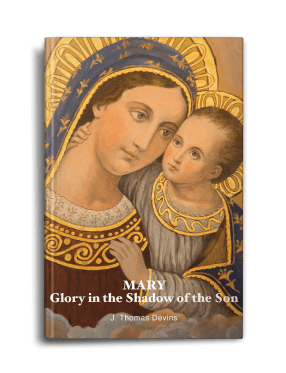
Mary
Glory in the Shadow of the Son
This new book asks an old question: “Which came first, the chicken or the egg?”
Is it correct to shape the Virgin Mary’s story as a subset of a greater Jesus story? Or, should it be the other way around? We must face the facts. The apple never falls to far from the tree. Of course, first century Israelites also knew that the apple didn’t fall to far from the tree….the father’s tree. The mother contributed nothing to the baby’s genealogy. Mary was, it was believed, just a carrier. In the Gospels, Mary is given special consideration as a carrier for She had special cargo: God’s Son, Jesus. Otherwise, She contributed nothing, or so we are told, to His being. Her minor role in the Jesus story was to allow the Holy Spirit to impregnate her, bring the divinely created fetus to fruition and look after Him until He was about twelve years of age. After that, He mysteriously disappeared for eighteen years at which time His short one to three year ministry began.
Jesus’s story has major holes in it. It falls apart when we understand that His great accomplishment, the so-called resurrection from the dead, wasn’t all that singularly great. Tibetan Buddhists have been “resurrecting” since before the Christian era, even in modern times. The phenomenon is called rainbow body. In the Tibetan practice, that which we Westerners call resurrection from the dead is shown to be possible for those who prepare while alive. In other words, resurrection is a teachable skill, the natural way the human body is designed to gracefully exit the planet. There is at least one school in Tibet that teaches how.Jesus isn’t the only Westerner to resurrect from the dead in the Christian era. One other person accomplished it. Mary. That She did is an article of faith in the Catholic tradition; it is non-debatable. Rather than consider that She had the necessary credentials, Her great accomplishment of resurrection is called “assumption.” Assumption embeds the notion that Her rising, body and soul, was done under Jesus’s power. That is, it was not something that She did on Her own. Her spiritual claim to afterlife fame thus comes as a reward for agreeing to be impregnated by the Holy Spirit and become carrier for God’s Son. So, in the story, Jesus’s resurrection comes easily by virtue of His divine Sonship. Mary’s comes easily by reward. Those who resurrect in the Tibetan tradition—and there are thousands of them— have to work at it in a practice that involves many years of denial. In the story, Jesus and Mary (especially) get a free pass.
The author ponders: there is something basically wrong with this picture. One of the benefits of those who achieve this pinnacle of spiritual perfection and earn eternal life is the ability to reappear in the material world from time to time in order to illuminate the path for others. The Tibetan Buddhists recognize such people in their tradition and say they have Sambhogakaya nature. Mary has appeared in the material world over 2,000 times since the first century. It is She, not Jesus, who dramatically appears to us in modern times, revealing the thin line that separates this life from the next while teaching what we must do to prepare for transition when our individual clocks strike midnight for the final time.
The author concludes that the lop-sided reverence we give to Jesus over Mary is like putting the cart before the horse. He uses the book to knock Mary off of the pedestal that She currently occupies, being there because of divine favor, and places her on an even higher one; one that She had to claw up Herself, as any true mother would do for her children.
In The Works
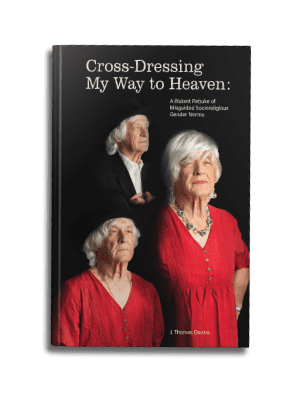
Cross-Dressing My Way to Heaven
A Blatant Rebuke of Misguided Socioreligious Gender Norms.
Spiritual perfection is realized when all dual thought is eliminated from the mind stream. Through a life-long meditation practice, spiritually realized Tibetan Buddhists overcome life’s final dual hurdle…mind/body… and transform their bodies to formless spirit in a centuries old phenomenon known as rainbow body. Here, the practitioner trains to look through the extreme diversity found throughout reality and find primordial sameness. Thus, dualities such as tall/short, fat/skinny, ignorant/smart and so forth are eliminated in favor of oneness. Of the dualities modern man must overcome, the male-female binary is arguably the most difficult. This is primarily because male-female differentness is flirtatiously framed and commercially exploited using an unwritten dress code which is enforced through social norms and Bible based religious teaching. Harsh punishment in the form of harassment, ridicule and sinner accusations await those who violate the code. Modern socioreligious gender norms work to make rigid a male-female duality that blocks the path to oneness and spiritual realization
True to his rebel nature, the author deliberately and blatantly violates the dress code in order to punctuate its discriminatory tone and irrelevance, redirecting man’s attention to the genderless state that God intended (Genesis 2:25) all along. Here he models his life-long hero, Jesus of Nazareth…brash, provocative, rule-breaker extraordinaire who had zero tolerance for meaningless, destructive norms of His time (e.g., dining with sinners and tax collectors).
There are men/women bathrooms and men/women clothing departments. But, there are no men/women cemeteries. When the trumpet blows for the last time the sameness of everyone is revealed. Spiritual perfection awaits those who come to terms while still alive.
Don’t be misled by the carnival sounding title of the book. It contains a serious message that will change your life if you let it.